
A new original song and aerial film explores the landscape and history of Twofold Bay, Boydtown and the Seahorse Inn, accompanied by an immersive 360° view and new panoramic photographs of the bay.
There are places that make more sense when you see them from the air. Twofold Bay is one of them. From above, the reason for the name becomes almost obvious as the coastline opens into its great curves of water, bounded by forested hills, long beaches and headlands reaching towards the Tasman Sea.
On 17/09/2026 I flew the drone over Boydtown and the historic Seahorse Inn, capturing new video, high-resolution panoramas and a complete 360° aerial view. The result became more than another drone flight. Looking down on the Inn, the beach and the enormous sweep of Twofold Bay suggested a story, and that story became a new original song, Two Folds of the Sea.
 A song about the bay, not just the buildings
My earlier song about the Seahorse Inn, Where Dreams Still Stand, concentrated on the old Inn and Boydtown. This time I wanted to pull the camera, and the story, much further back.
Two Folds of the Sea treats the bay itself as the constant character. People arrive, build, hunt, trade, dream and disappear, but the rivers continue to reach the sea and the tide continues to return.
The song begins before the European names appeared on maps, acknowledging the Thaua people and their long relationship with this coast. It then follows George Bass and Matthew Flinders, the whaling years, the remarkable relationship between Eden's whalers and the killer whales of Twofold Bay, Benjamin Boyd's ambitious settlement at Boydtown, and finally returns to the landscape we see today.
Two folds of the sea
Holding the mountains and sky
Two arms opening out to the east
Where the wandering oceans lie
 Watch Two Folds of the Sea
The video is built around the aerial landscape rather than attempting to illustrate every historical line literally. The drone can do something Bass, Flinders, Boyd and the early whalers could never do: rise above the shoreline and reveal the whole geography in a single view.
One lyric came directly from that thought:
But what they could measure from timber and sail
I can see in a single slow climb
From several hundred feet above Boydtown, the Seahorse Inn becomes only one part of a much larger picture. The beach curves away, waterways cross the flats, Eden sits beyond the water and layers of forest and ranges fade into the distance.
 Long before Boydtown
The history of Twofold Bay did not begin with Benjamin Boyd. The area forms part of Thaua country, within the broader Yuin cultural region, and Aboriginal connections with this coastline extend back thousands of years.
European exploration brought a new set of names and maps. George Bass explored this coastline in his small open whaleboat in 1797 and 1798, and he and Matthew Flinders later surveyed Twofold Bay. The unusual geography of its two major reaches gave the bay the name it carries today.
Whaling subsequently became central to Eden's early European economy. NSW National Parks records the establishment of mainland Australia's first shore-based whaling station at Twofold Bay in 1828.
 When the killer whales came
Of all the stories associated with Twofold Bay, perhaps none is more remarkable than the relationship between the whalers and the killer whales.
Orcas entering the bay would help locate and herd migrating whales. The best known was Old Tom, remembered for alerting whalers to the presence of whales and participating in the chase. The Eden Killer Whale Museum records that Tom was known to swim to the mouth of the Kiah and slap the water with his tail to attract attention.
That history gives the song one of its strongest images:
And black fins cutting the silver swell
Where they had hunted long before
From the modern aerial view, it is easy to imagine those open whaleboats moving across what now appears to be an enormous, peaceful sheet of blue.
 Boyd's extraordinary dream
Benjamin Boyd arrived in the district in the early 1840s with ambitions that went far beyond building an inn. He wanted Twofold Bay to become an important port serving his vast pastoral holdings on the Monaro and further inland.
Boydtown was planned with workers' cottages, stores, port facilities, a church and the Seahorse Inn. Construction began during 1843 and 1844, while Boyd also developed whaling and shipping operations around the bay.
It was an enormous undertaking, but it did not last. By 1849 Boyd's Twofold Bay operations had ceased and much of the settlement gradually disappeared or returned to bush. The Seahorse Inn survived, along with Boyd's Tower across the bay, as physical reminders of just how ambitious the plan had been.
The song compresses that rise and fall into a few lines:
Sandstone walls and a grand design
Wool coming down from the plains
But money ran out and the ships moved on
And the bush took the streets back again
 Step inside the view in 360°
The 360° aerial panorama provides a completely different way to explore the location. Instead of deciding where the viewer looks, the panorama lets you turn through the entire landscape.
Look towards the water and the scale of Twofold Bay becomes apparent. Turn inland and the coastal flats give way to bush-covered hills and distant ranges. Below sits the Seahorse Inn, surrounded by lawns and mature trees, while the beaches extend in both directions around the bay.
On a phone or tablet the view can be explored by moving around the scene. With a VR headset it becomes much closer to standing in the air above Boydtown.
 Twofold Bay as a panoramic artwork
The same flight also produced a series of wide panoramic photographs designed for large-format display. This landscape particularly suits the format because it is not really a single-subject photograph. The eye travels through it.
One panorama looks along the coast with the Seahorse Inn below, Twofold Bay opening beyond it and the sun dropping towards the ranges. Another turns towards the broad water of the bay, placing the Inn between the beach and the historic Boydtown landscape.
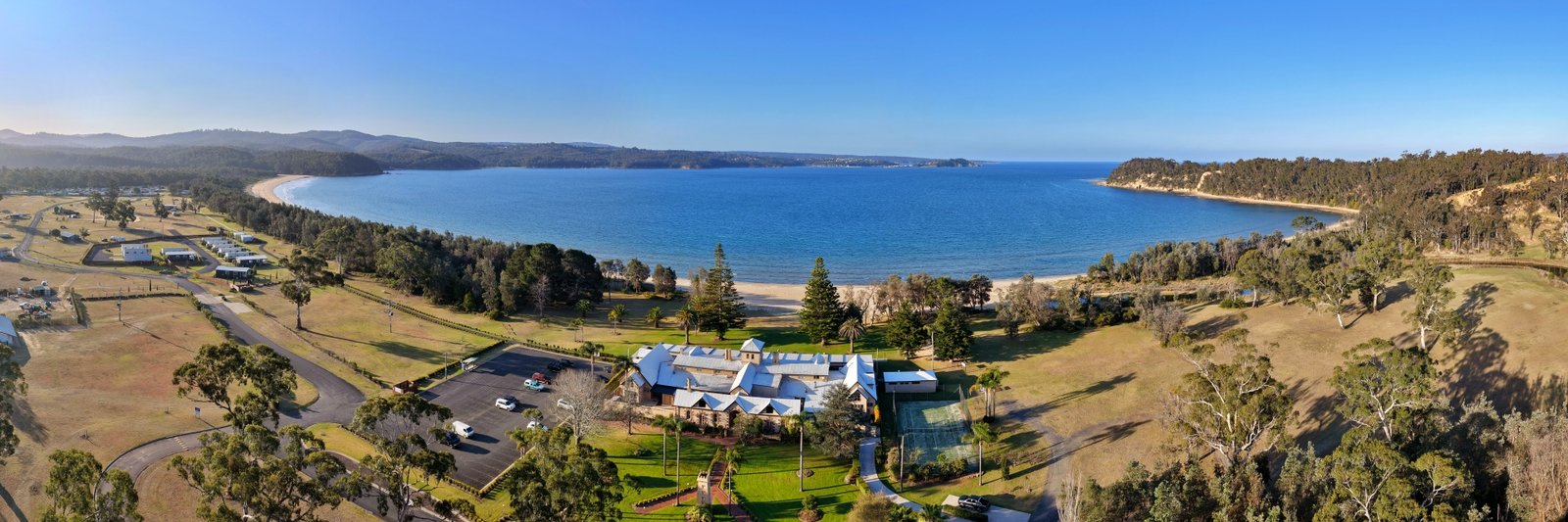
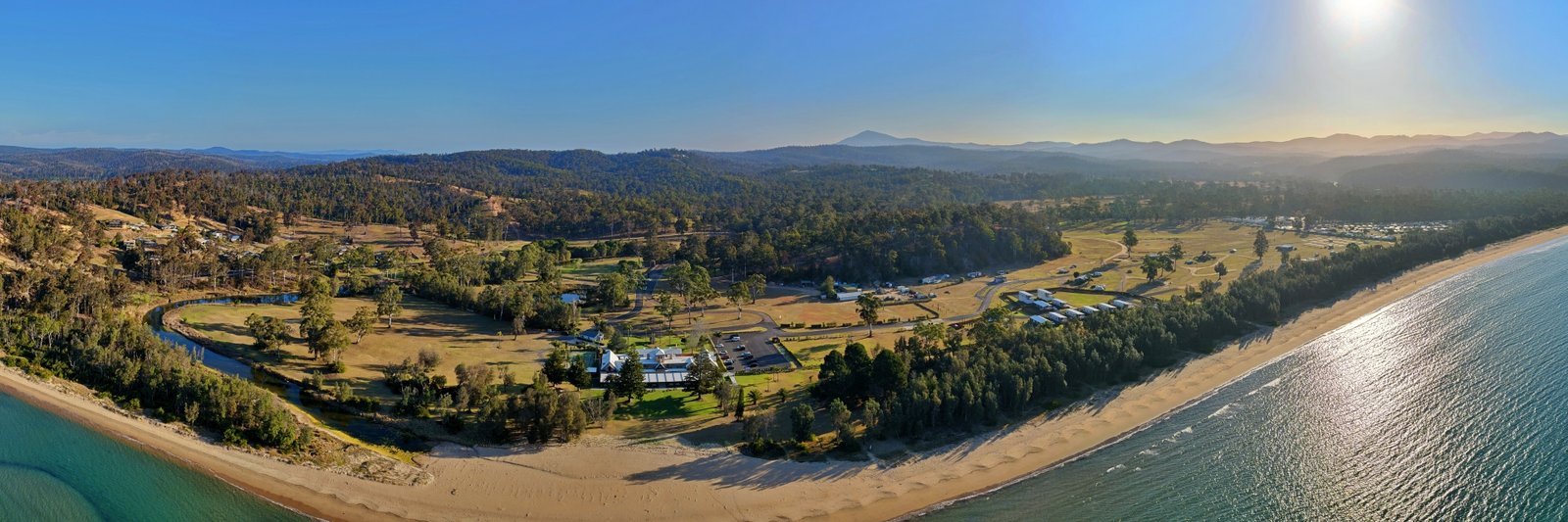
Selected Twofold Bay and South Coast panoramas are available as large-format wall art through OzeArt, including framed panoramic canvas options.
These are produced from the high-resolution master panorama files rather than frames extracted from the video, allowing the detail of the coastline, trees, buildings and distant landscape to survive at substantial print sizes.
 And the bay remembers
What interested me most while making the song was the difference between human time and landscape time. Bass passed through. Whaling fleets came and went. Boyd built an entire settlement around an idea of what Twofold Bay might become. Most of it disappeared.
Yet from the air, the geography that shaped all those stories is still immediately recognisable. The rivers still find the bay, the ranges still sit behind it and the open Tasman still fills the horizon.
That became the final thought of Two Folds of the Sea:
Whatever we build, whatever we name
Whatever we carry away
The rivers still run to the waiting blue
And the tide comes home to the bay
And after everything else has faded:
The years move on
And the bay remembers them all.
